data.json — The Hidden State
Essay 7.4 — The Plugin Kit, Part 4 of 9.
Essay 7.3 opened the two voice surfaces — one for the LLM, one for the operator — and named Lock 13 as the policy that governs when soft coaching hardens into a deterministic block. This sub-essay opens the organ that carries the plugin’s state — and the discipline that keeps it from being corrupted by concurrent reads, partial writes, or cross-plugin reach-arounds.
data.json — The Hidden State
What it is. The plugin’s private runtime state. The active focused job, the tier counter, the summary chain, the lock manifest. JSON-encoded, written atomically, lives only on the operator’s machine, gitignored. ⓘ
Who reads it. ONLY the plugin’s own scripts. No other plugin reaches into this file. The discipline is structural: cross-plugin queries route through the plugin’s published read-only commands (job.sh focused, phase.sh current), never through cat data.json from outside. ⓘ
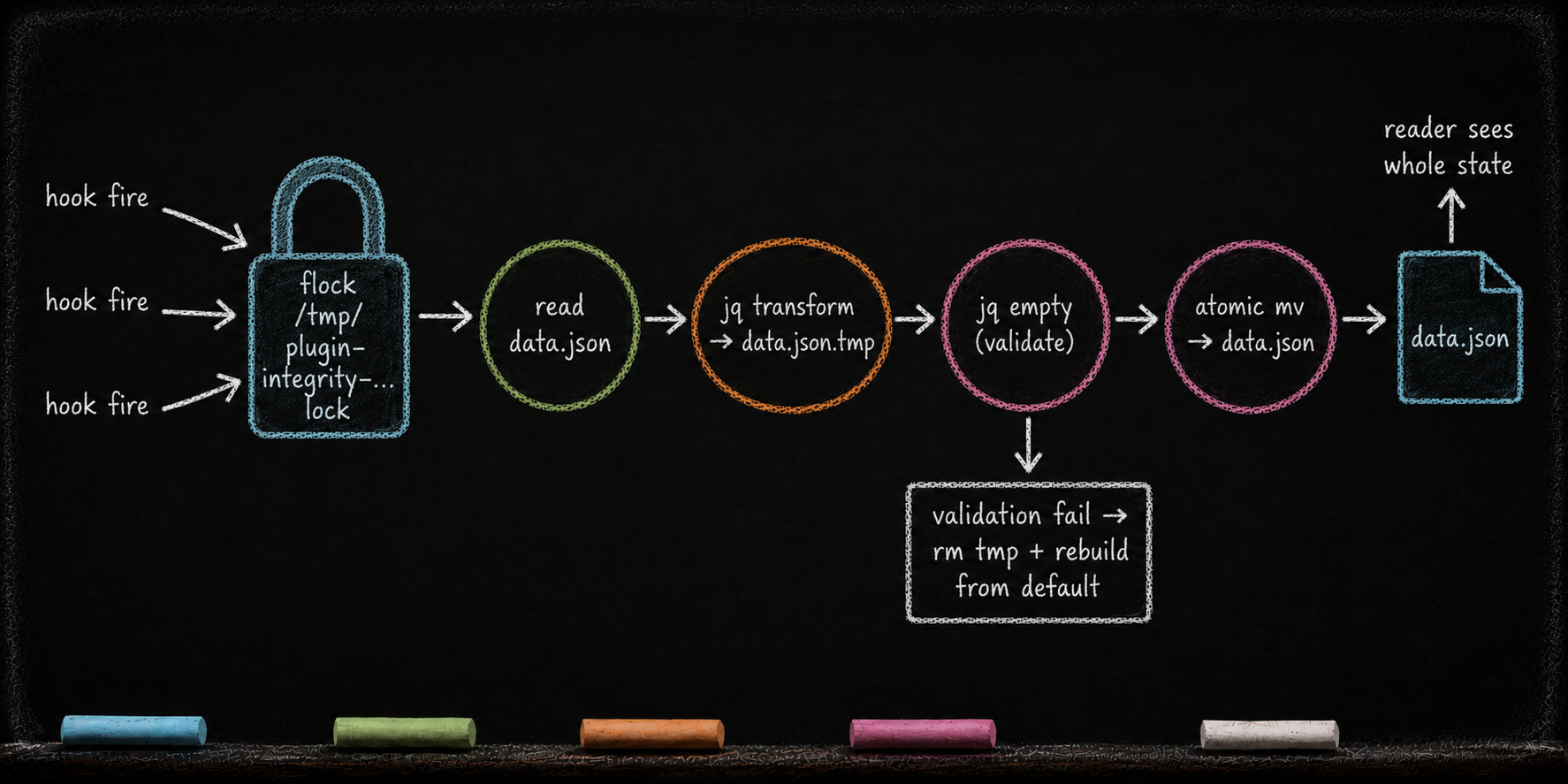
Who writes it. ONLY the plugin’s own scripts. Direct file-system writes are forbidden. Every mutation follows the same protocol: flock on a /tmp/-located lockfile serializes concurrent hook fires. Inside the lock, the script reads current state, transforms it through jq into a temp file, validates with jq empty, then atomically mvs over the live file. The reader never sees a partial state. If parsing fails at read time, the gateway script rebuilds the file from defaults rather than blocking the agent. ⓘ
What it depends on. The plugin’s scripts (which mediate every read and write). The shared lib/voice-helper/ (for error messages when validation or atomicity fails). ⓘ
Why the mandatory script-mediation. Multiple subsystems may fire hooks against the same data.json within milliseconds of each other (e.g., two PreToolUse hooks from the same plugin both reading state). If both write directly to the file, one overwrites the other’s update. The flock discipline serializes all mutations through the script gateway. Reads also go through scripts so corruption is handled fail-safe: when data.json is malformed, the script rebuilds rather than crashing the agent. ⓘ
But "fail-safe" is not the same answer everywhere. Rebuilding is the right move when the lost state is cheap — a tier counter or a phase marker reconstructs from defaults with no harm done. Where the state is not cheap, the same corruption demands the opposite reflex. The job lifecycle plugin’s stop-gate refuses to release the agent while it cannot read the job records: a malformed data.json there means the gate fails toward blocking, not allowing. Silently resetting job state to a clean slate would erase work the agent has not finished — so the safe outcome is to halt and force a repair, not to wave the agent through on an empty rebuild. Forgiving where loss is cheap; refusing where loss is not. ⓘ
The boundary is structural, not OS-level. An operator who edits data.json directly bypasses the protocol entirely. The discipline holds because the seed agent and historian both refuse to write outside their scripts — a publishable-interface contract, not a kernel lock.
The state schema upgrades itself. A plugin’s state grows new fields over time. The kit handles this without a migration step the operator has to run. Every data.json carries a schema_version number, and the plugin’s scripts hold a short stack of idempotent helpers — one per field that was ever added. Each helper does the same small thing: check whether its field is present, add a default if it is missing, and no-op if it is already there. The plugin’s command router runs the whole stack before it touches any subcommand, so an old data.json upgrades itself the first time any command fires against it. There is no version-mismatch rejection and no "run the migration" ceremony — the file just reaches the current shape on first touch. ⓘ
Target asset: assets/images/blog/b7/data-json-atomic-protocol-b7-4.png
The new-plugin lens. When you guide your seed to add a plugin that needs state, the seed designs the state’s interface first: what read commands does this plugin publish for other plugins (and the agent) to use? What mutation commands does this plugin publish for its own hooks to use? Then data.json becomes the cache the scripts operate on. Tell your seed: if you cannot enumerate what reads each field and what writes each field, the design is not done yet. A real-estate broker’s seed could carry an open-listings manifest the same way; only the listings plugin’s scripts mutate it, and concurrent showings-update hooks serialize through the same flock protocol.
The minimum-viable plugin shape. A plugin without data.json is stateless — it carries no runtime bookkeeping. question_discipline is again the example: pure gate, no state, no data.json. The absence signals stateless enforcement. ⓘ
State is private. Mutation is serialized. Cross-plugin queries route through the script CLI, never through the raw file. The next sub-essay opens the organ where the plugin’s narrated knowledge lives — docs/, including the word-capped evolution.md and the historian ratchet that auto-injects it before every edit.
Essay 7.4 — The Plugin Kit, Part 4 of 9.
Previous: Essay 7.3 — The Dual Voice Architecture — two voice.xml files, one for the LLM and one for the operator. Next: Essay 7.5 — docs/ and the Historian — evolution.md word-capped + the historian ratchet.
Comments