Structured Questions — question_discipline
Essay 5.6 — The Always-On Digital Cortex, Part 6 of 9.
Essay 5.5 covered the mega-prompt that grows with every question. This part covers the gate that grew the asking surface itself into something architectural — every question the seed agent asks the user carries a registered prefix, and the rest of the seed’s machinery dispatches on those prefixes.
What it owns
question_discipline exists to make every question the seed agent asks the user structured. It works by gating every AskUserQuestion call against a small list of registered prefixes — only registered question forms get through. Most registered forms are ceremonies (locks, approvals, completion claims), and [WAITING] is the deliberate generic escape valve. It applies on the main agent’s AskUserQuestion surface, with one deliberate runtime exception for dispatched subagents. ⓘ
How it works — batch-cascade against the registry
A pre-call hook walks every question in the call and matches its first token against a small registry of approved prefixes hardcoded in the script. The registry is short — most entries name very specific ceremonies (unlocking a plugin, approving a job, promoting a job to repeating, reporting upstream, authorizing a plugin-editing job at creation, and the others), and one ([WAITING]) is the deliberate generic — a catch-all for the cases where the seed agent legitimately needs input from the user and the situation does not fit one of the structured ceremonies. The prefixes cascade: when the agent batches multiple questions in one call, every question must carry a registered prefix, or the entire batch is rejected and the agent has to rewrite. The plugin owns no hidden state; the registry is its only state. ⓘ
Dispatched subagents present a non-main agent_type in the hook’s stdin JSON payload, and the gate reads it and exits 0 before walking the registry — because a subagent is not supposed to become a second user-facing conversation surface. Their job is focused investigation; if they need user input, the cleaner pattern is to report the uncertainty back to the parent agent, which asks through the registered prefix system. The bypass is the one runtime exception the registry admits — every main-agent ask must clear a prefix, no matter which plugin’s hook is firing or which phase the agent is in. This draws the boundary at the user-facing main-agent surface; extending the same discipline recursively into subagents is a customization choice, not the current prototype’s default. ⓘ
How shape compels cognition — per-prefix admission gates
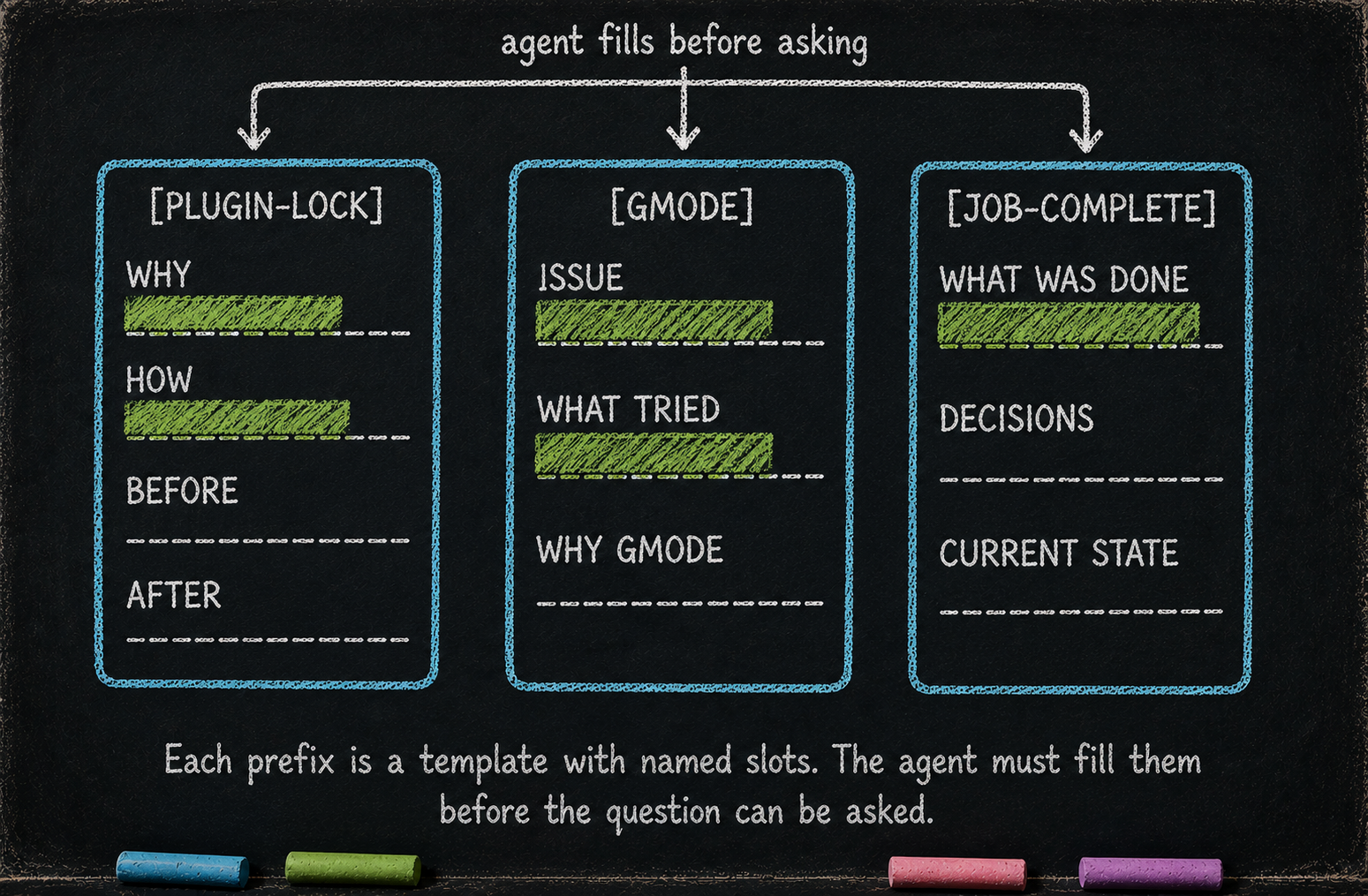
Past the registry gate, every admitted prefix lands in its owner plugin’s per-prefix handler — and that handler is where the shape lives. Each handler demands a different slot-set the seed agent must fill before the question reaches the user. [JOB-COMPLETE] checks several slots: the focused job’s name in the body, the literal Review option label, the literal Approve completion option label, and a ≥100-word body. [JOB-APPROVE-CREATION] — the ceremony that authorizes a plugin-touching job (Essay 5.9) — demands its own slot-set naming the proposed objective, the plugins to touch, why now, and the risk surface. [PLUGIN-LOCK] and [TEST-LOCK] check a ≥100-word body plus a plugin-name or filename regex on the header. [GMODE] checks a ≥100-word body plus the [GMODE] <reason> format. ⓘ
The shape IS the cognition — filling each slot is structured reasoning the gate forces before the user is asked. The seed agent cannot ask [JOB-COMPLETE] without first writing a substantial review block (the current prototype floors it at a hundred words); it cannot ask [JOB-APPROVE-CREATION] without naming the plugins the proposed job would touch and its risk surface; it cannot ask [GMODE] without justifying the maintenance the mode opens. The slot-set IS the agent’s compelled think-through. Each handler is a tiny stencil; what makes it work is that the agent has to fill it before the question can land. ⓘ
Coverage is uneven by design. The ceremonies whose answer drives state changes — job completion, plugin-touch authorization, plugin unlock — carry the heaviest slot enforcement. The lighter prefixes ([WAITING] among them) check format and admit. Two surfaces ([REPORT-TO-UPSTREAM], [JOB-APPROVE-CREATION]) capture the user’s answer after it lands — admission shape lives on the answer side, not the question side. Whether to extend the per-prefix section shape (each ceremony’s own named slots — Plugin / Specific Changes / Why / Tests Will Run for a plugin unlock, say) to every prefix is the next maturation question — measure where word-floor falls short before hardening the registry into stencils. ⓘ
Shape lives on both sides — the question body and the option labels — and the design that closes the coverage gap is to give every prefix a body section-set that names what the question is FOR, plus an option-label set that names what the user is choosing between. [WAITING] is the test case for the body side. Today it admits any non-empty reason after the prefix; the next iteration would carry two required body sections — the actual question, and a justification block explaining why this needs user input and isn’t a decision the seed agent should make alone. The shape block becomes the seed’s own self-check: if it can’t write the justification, it doesn’t ask the question. The gate stops being a registry-membership filter and starts being a low-value-question filter — the agent reasons about whether the ask is worth the user’s attention BEFORE making it. ⓘ
The same discipline generalizes to every prefix; each body shape names what the question is about, which forces the seed to decide what it’s about to do BEFORE handing the choice to the user. The coverage gap closes when every prefix carries a shape rich enough that filling it is the thinking — and the registry stops being a membership filter, becomes a slot-cognition filter that turns each ask into a deliberate, structured move.
There is one more turn of this idea, and it belongs to the job rather than the prefix. The per-prefix catalog is fixed — every job’s [JOB-COMPLETE] answers the same standard sections. But a long job often has its own evidence dimensions the standard sections don’t capture. So beyond the catalog, a single job can carry its own Extended shape: a handful of extra ## sections with flexible, job-specific titles — ## Plugin Surfaces Touched This Run, ## Visual-Asset Implications — that this one job declares are part of what "done" means for it. The job names those sections early, while it is first loading context, and from then on they ride alongside the standard ones. When the final cycle’s [JOB-COMPLETE] question fires, the completion check validates the standard sections and the job’s own declared sections — all present, all filled — before the question can reach the user. ⓘ
The shape of the idea is clean, and the prototype ships it: the job field holds the declared section titles, a cycle-1 setter lets a job declare them, the cycle-1 OBSERVE advance checks the declared sections exist in the expanded objective, and the inheritance check folds them into the completion gate. Each job carries its own definition of finished evidence without ever touching the shared per-prefix catalog. The catalog stays the same for everyone; the job adds what only it cares about. ⓘ
What would break without it
Without question_discipline, every AskUserQuestion is fair game — the agent’s asking surface bloats with low-value confirmations, and the structured ceremonies (locks, approvals, completion claims) lose the prefix scaffolding the rest of the always-on layer uses to dispatch on. ⓘ
What you would customize
question_discipline is the smallest plugin in the always-on layer but the most catalytic — every new ceremony in the rest of your seed needs an entry here. ⓘ
You would extend the registry. The current registry is this prototype’s catalog of structured-asking situations. Your seed will need its own — a research seed may want [CITATION-CHECK] for verifying a quoted source; a consulting seed may want [CLIENT-APPROVAL] for the equivalent of a client sign-off on a deliverable. Each new entry pairs with: a per-prefix handler in the plugin that owns the ceremony, a voice for failure messages, the slot-set the handler demands (see How shape compels cognition above — word-floor, named-token requirements, option-label requirements, phase or state matches), and a clear semantic — what kind of question this prefix marks. Names are cheap; the discipline is in keeping each prefix narrow and orthogonal — and in making the slot-set rich enough that filling it IS structured thinking. ⓘ
You would tune the batch-cascade strictness. The current shape rejects the entire batch on any unprefixed question. A more lenient shape might accept partial batches (process the prefixed questions, drop the unprefixed). A stricter shape might require the same prefix across all questions in a batch (preventing prefix mixing). The cascade is the discipline; the exact rule is yours. ⓘ
You would re-think the subagent bypass. The current prototype lets dispatched subagents bypass the gate because they should not become a second user-facing question surface; uncertainty should route back to the parent agent, which asks through the prefix system. Your architecture may prefer to extend the same discipline downward — every subagent question also carries a prefix, every ceremony reaches recursively. The trade-off: more discipline but more ceremony in subagent dispatch. ⓘ
You would add the [WAITING] escape valve or remove it. The current prototype keeps [WAITING] as a deliberate generic for situations that don’t fit a structured ceremony. Your seed may decide that the escape valve is a leak — and every question must fit one of the named ceremonies. Tightening the registry tightens the architecture; loosening it eases day-to-day work. Both are defensible. ⓘ
What you would not do is leave the gate off. Without it, the asking surface bloats with casual "proceed/pause/continue" confirmations, and the rest of the always-on layer’s prefix-dispatched ceremonies (PLUGIN-LOCK, JOB-COMPLETE, JOB-APPROVE-CREATION) lose the scaffolding they hang on.
That closes the tour of the always-on plugins. The next part covers one of the substrate forms underneath them — the working-memory form, the CLAUDE.md hierarchy that the phasic layer writes through. The substrate as a whole holds many forms; the CLAUDE.md hierarchy is the one with a structured-edit protocol the always-on layer touches directly.
Essay 5.6 — The Always-On Digital Cortex, Part 6 of 9.
Previous: Essay 5.5 — Mega-Prompt Compression — interaction_summary — block-until-summarized. Next: Essay 5.7 — The CLAUDE.md Hierarchy — working memory bus, footer protocol, altered list.
Comments